
Swiss-type turning
Swiss-type turning up to ø32 mm for slender, complex precision parts with tight tolerances and high surface finish.
- Swiss-type turning up to ø32 mm
- Slender parts with high length-to-diameter ratio
- Complex geometries completed in one process
- Unmanned operation with bar feeder
For medical and precision engineering
Swiss-type turning is ideal for small, complex parts in large quantities, typically for medical devices, instrumentation and precision assemblies.
- Stainless and acid-proof steel
- Free-cutting steel
- Aluminium
- Brass
- Engineering plastics (POM)
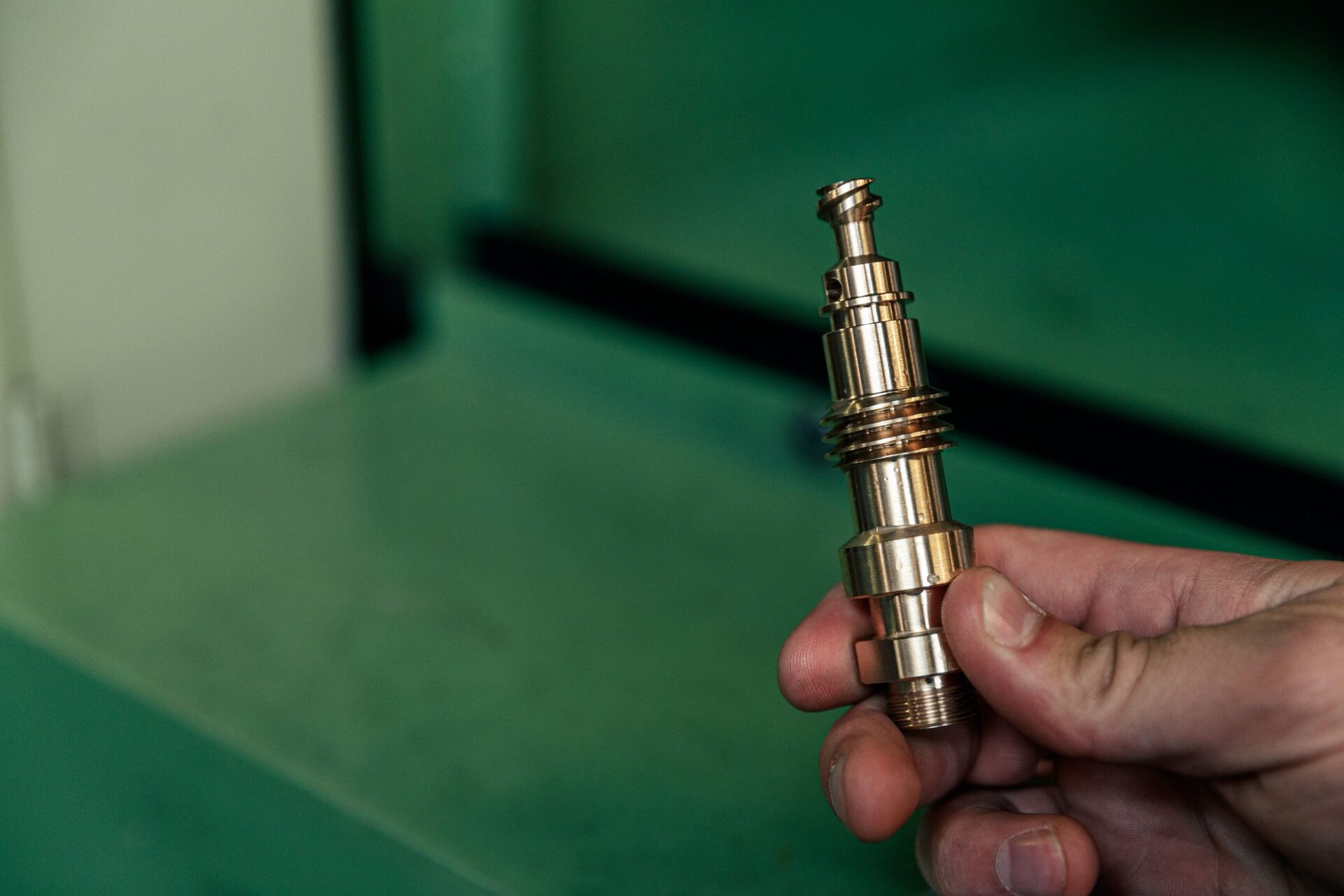
The guide bushing's role in stability and tolerance
In Swiss-type turning, material is fed through a guide bushing positioned close to the cutting edge, which sets the process markedly apart from conventional turning. The short, supported distance between guide bushing and tool minimises deflection of the part during machining, making it possible to hold tight tolerances even on parts with a high length-to-diameter ratio, where conventional turning often produces vibration and an unstable surface.
The increased stability also lets us work at higher cutting speeds on slender parts without compromising surface quality. That gives a shorter cycle time per part than would be possible on a conventional turning machine with equivalent geometry, and it is a major reason Swiss-type turning is often the economically correct process at high unit counts.
The precision of the guide bushing is maintained continuously, because even minor wear in the bushing can propagate into the part's tolerance over a long production run. We check the bushing's condition as a fixed part of our preventive maintenance, so the process remains stable throughout the machine's operating life, not just in the first months after setup.
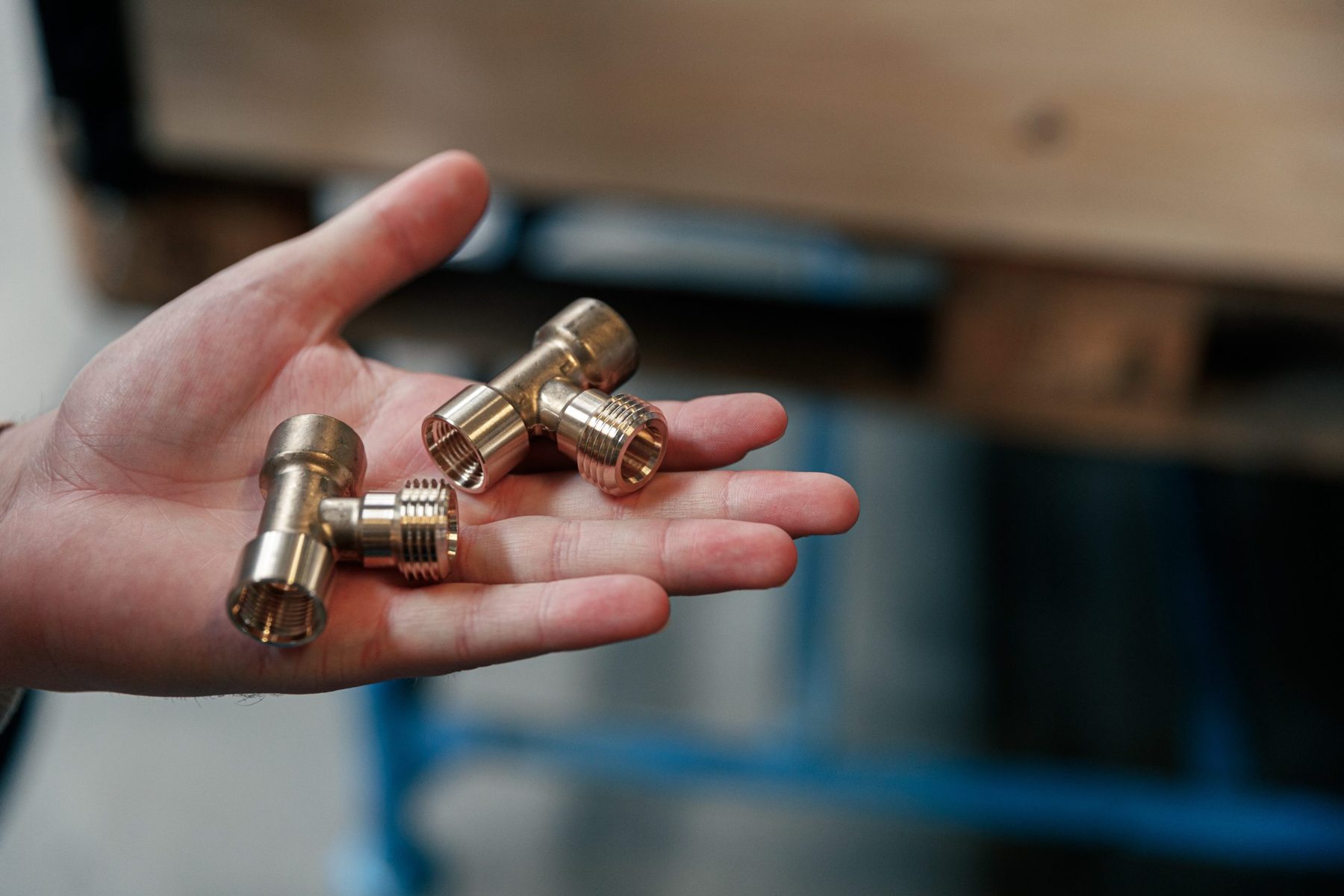
Material choice for slender, Swiss-turned parts
We Swiss-turn up to ø32 mm across a broad range of materials, including stainless and acid-resistant steel, free-cutting steel, aluminium, brass and engineering plastics. Each material requires its own combination of cutting speed and feed to avoid vibration on the slender geometry typical of Swiss-type turning, and that knowledge is built into our process setup, so a material change does not require a lengthy new commissioning period.
Free-cutting steel is often the first choice where function allows it, because the material is designed for exactly this type of high-speed machining and gives good chip breaking and a clean surface without extra finishing. Where corrosion resistance is required, we correspondingly work with stainless and acid-resistant steel, adjusting process parameters to compensate for the material's toughness.
For parts where weight is a key parameter, we use aluminium, which can be Swiss-turned at high cutting speeds and gives a light but stable part. Engineering plastics such as POM are used where electrical insulation, chemical resistance or low weight are essential, and here tool geometry is adjusted to avoid melting and material build-up on the edge.
Driven tools and back working in a single sequence
With driven tools on the Swiss lathes, a part can go through several machining steps in a single setup: cross drilling, milled faces, countersinks and threading, all while the part is still held in the primary setup. That means the mutual tolerances between these features can be held very tight, because there is no re-clamping between steps.
Back working allows the reverse side of the part to be finished immediately after it is parted off from the bar, without manual handling between primary and back-side machining. That reduces both lead time and the risk of introducing errors in the transition between the two machining stages, and it means the part leaves the machine as a finished component.
The high degree of integration in the process places great demands on programming and tool planning, because several tools must be coordinated within a limited work envelope without colliding. We simulate these sequences thoroughly before releasing a new setup for production, significantly reducing the risk of errors when a new part type starts up for the first time.
Unmanned operation as a core part of the economics
The Swiss lathes run with bar magazines, making unmanned operation a natural part of the process rather than an exception. A full bar magazine can keep production running through an entire night shift, giving significantly higher use of machine hours than if the machine only ran during manned hours, and it is central to why Swiss-type turning is economically attractive in high-volume series.
Unmanned operation requires the process to be thoroughly validated before release, including monitoring tool wear and ensuring defective parts are sorted out automatically or detected quickly at the next manned shift. We use experience from previous orders to determine how long a given setup can run unmanned before supervision is needed.
The economic benefit of unmanned operation flows directly to the customer in the form of a lower unit price on large series, while delivery reliability increases, because production is not confined to normal working hours. That makes Swiss-type turning a natural choice when a part is slender, complex and needed in high volumes.
Applications in medical technology and precision mechanics
Swiss-turned components are widely used in medical devices, where requirements for surface quality, cleanliness and geometric precision are high, and parts are often small and complex. Here the combination of tight tolerance and fine surface finish works alongside the other documentation and traceability requirements standard in the medical industry.
In instrumentation and precision mechanical assemblies, Swiss-turned parts are typically used as shaft components, bushings and fasteners, where function depends on several small geometries fitting together precisely. Here it is often the mutual tolerance between several features on the same part, rather than any single dimension in isolation, that is the real challenge.
Hydraulic components, where sealing and movement depend on a very fine surface finish, are another typical application area. Here we work closely with the customer to establish which surface roughness is actually needed, since an unnecessarily fine finish can add cost to the process without a corresponding functional benefit.
Starting up new Swiss-turning jobs
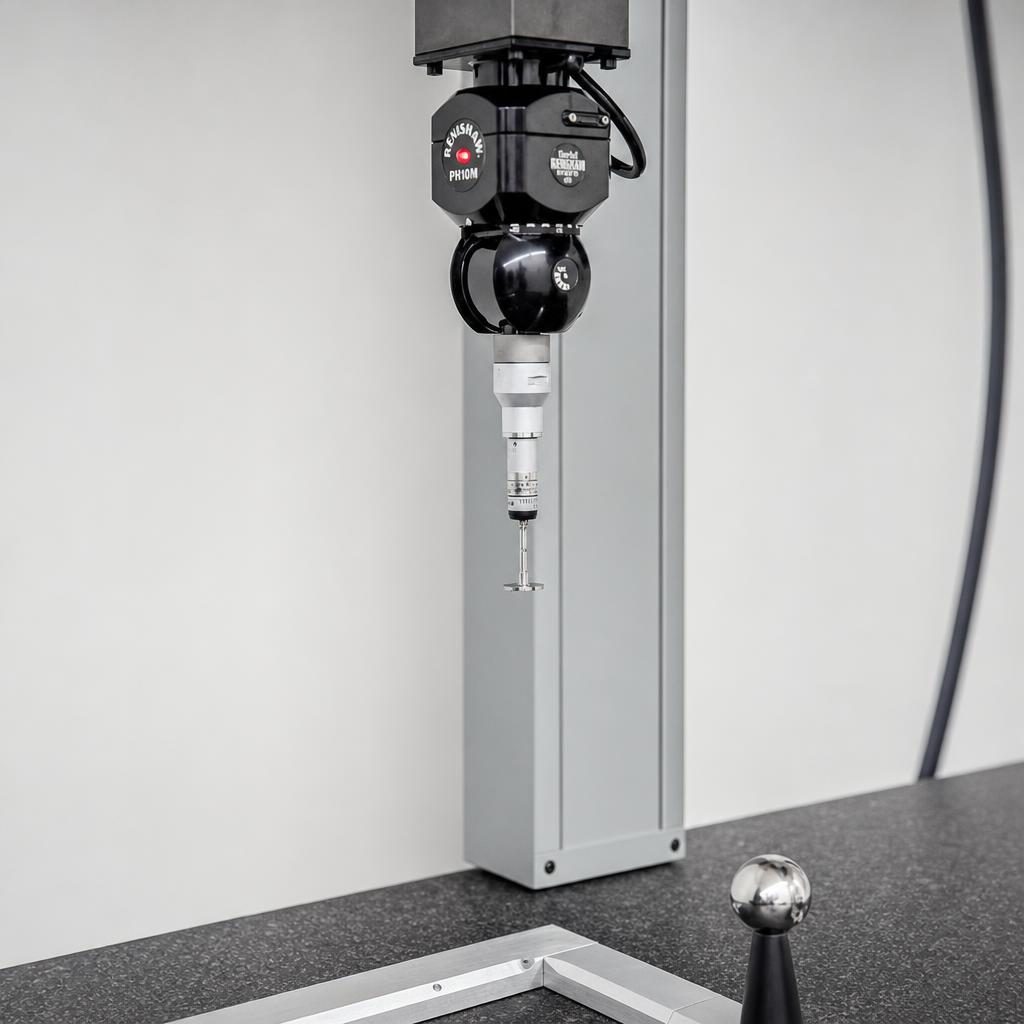
When a new Swiss-turning job is received, we review the drawing focusing on which features can be produced with driven tools and which require a separate operation. This assessment affects both price and cycle time, and we are happy to give feedback early if a minor adjustment to the geometry can move a feature from a separate operation into the integrated process.
Trial parts are produced before a series is started at full scale, so both process and inspection plan can be validated on a small number of parts. At this stage we confirm whether the mutual tolerances between the various geometric features hold, and whether surface quality is stable, before moving on to unmanned series production.
Once the process is approved, fixturing, tool list and process parameters are documented, so a future re-order can be started without going through the whole development process again. That documentation is especially valuable for customers with irregular demand, where a long time can pass between two orders for the same part.
Measuring complex, small geometries
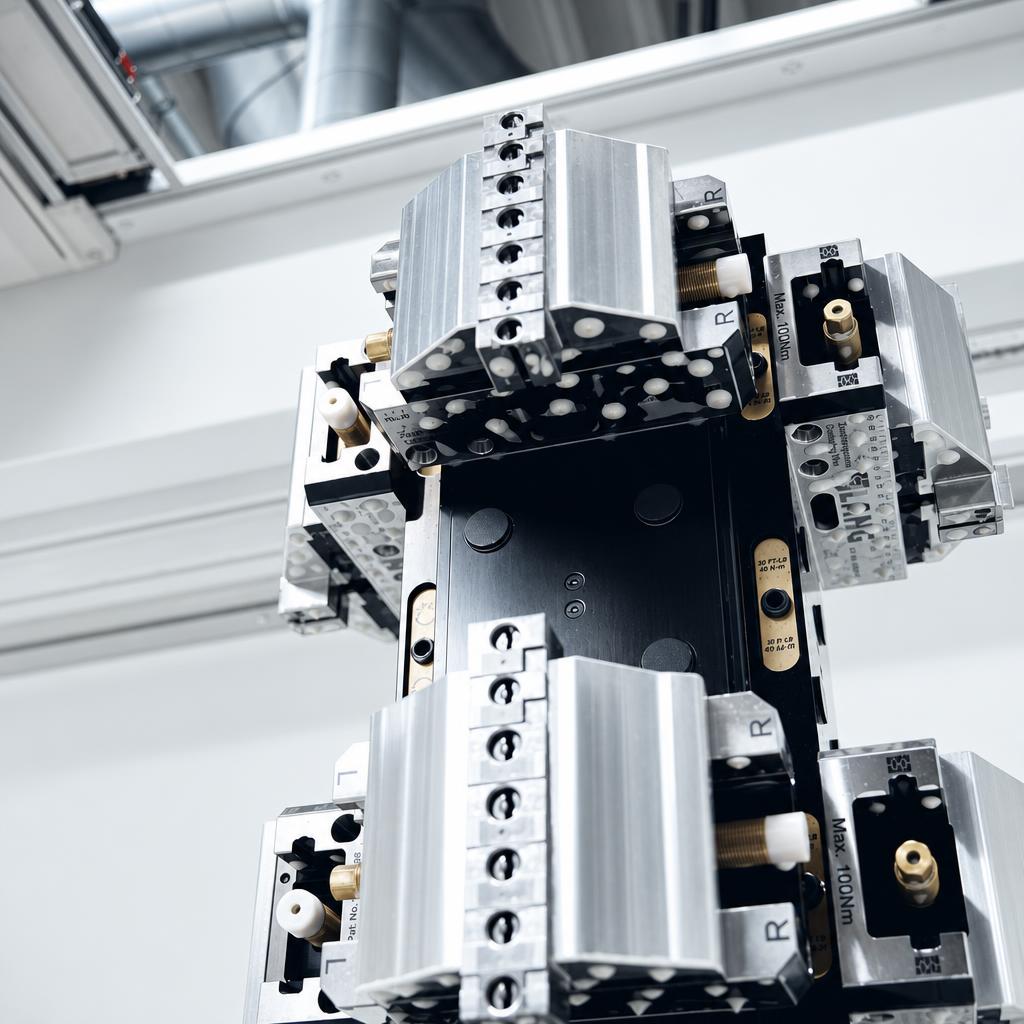
Swiss-turned parts are often small and geometrically complex, which places particular demands on measurement equipment. We use 3D measurement equipment capable of handling the fine detail and tight tolerances typical of Swiss-turned components, and the inspection plan is designed to cover critical dimensions without making the check unnecessarily time-consuming.
For parts with several critical features on the same component, we place emphasis on documenting the mutual relationship between dimensions, not only each dimension in isolation. It is often exactly that mutual relationship that determines whether the part functions correctly in the customer's assembly, and it is therefore a central part of the documentation delivered with the part.
Inspection reports are tailored to the customer's needs, and for customers requiring full traceability we can link a specific delivery to the material batch the parts are made from. That gives a documentation trail that can be traced back if questions about a specific delivery arise at a later date.
Shall we produce something for your company?
Send us your drawing and we will come back with a technical assessment and a quotation. We accept electronic drawings in most formats and treat all material confidentially.